PPT: Scalable IO in Java
Author: Doug Lea
Outline
- Scalable network services
- Event-driven processing
- Reactor pattern
- Basic version
- Multithreaded versions
- Other variants
- Walkthrough of
java.niononblocking IO APIs
Network Services
- Web services, Distributed Objects, etc
- Most have same basic structure:
- Read request
- Decode request
- Process service
- Encode reply
- Send reply
- But differ in nature and cost of each step
- XML parsing, File transfer, Web page
- generation, computational services, ...
Classic Service Designs
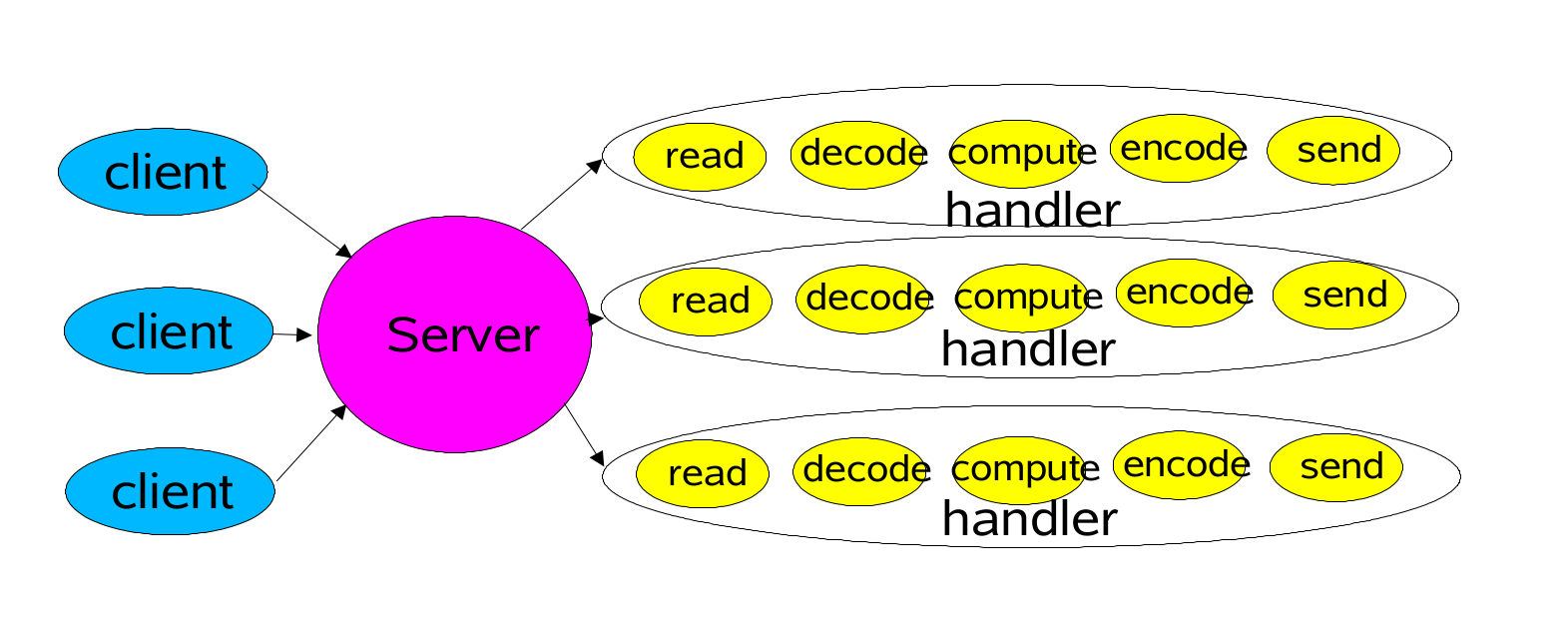
Each handler may be started in its own thread
Classic ServerSocket Loop
// Note: most exception handling elided from code examplesclass Server implements Runnable { public void run() { try { ServerSocket ss = new ServerSocket(PORT); while (!Thread.interrupted()) new Thread(new Handler(ss.accept())).start(); // or, single-threaded, or a thread pool } catch (IOException ex) { /* ... */ } } static class Handler implements Runnable { final Socket socket; Handler(Socket s) { socket = s; } public void run() { try { byte[] input = new byte[MAX_INPUT]; socket.getInputStream().read(input); byte[] output = process(input); socket.getOutputStream().write(output); } catch (IOException ex) { /* ... */ } } private byte[] process(byte[] cmd) { /* ... */ } }} |
Scalability Goals
- Graceful degradation under increasing load (more clients)
- Continuous improvement with increasing resources (CPU, memory, disk, bandwidth)
- Also meet availability and performance goals
- Short latencies
- Meeting peak demand
- Tunable quality of service
Divide and Conquer
- Divide-and-conquer is usually the best approach for achieving any scalability goal
- Divide processing into small tasks
- Each task performs an action without blocking
- Execute each task when it is enabled
- Here, an IO event usually serves as trigger

- Here, an IO event usually serves as trigger
- Basic mechanisms supported in java.nio
- Non-blocking reads and writes
- Dispatch tasks associated with sensed IO events
- Endless variation possible
- A family of event-driven designs
Event-driven Designs
- Usually more efficient than alternatives
- Fewer resources
- Don't usually need a thread per client
- Less overhead
- Less context switching, often less locking
- But dispatching can be slower
- Must manually bind actions to events
- But dispatching can be slower
- Usually harder to program
- Must break up into simple non-blocking actions
- Similar to GUI event-driven actions
- Cannot eliminate all blocking: GC, page faults, etc
- Must keep track of logical state of service
- Must break up into simple non-blocking actions
Background: Events in AWT
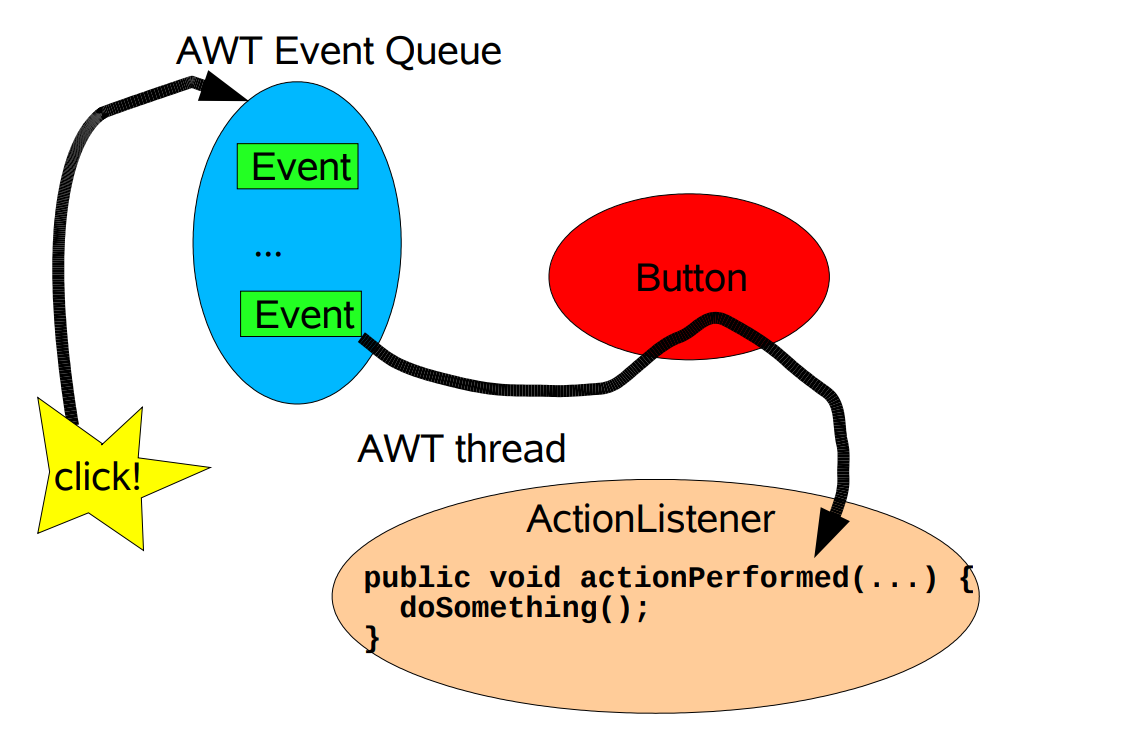
Event-driven IO uses similar ideas but in different designs
Reactor Pattern
- Reactor responds to IO events by dispatching the appropriate handler
- Similar to AWT thread
- Handlers perform non-blocking actions
- Similar to AWT ActionListeners
- Manage by binding handlers to events
- Similar to AWT addActionListener
- See Schmidt et al, Pattern-Oriented Software Architecture, Volume 2 (POSA2)
- Also Richard Stevens's networking books, Matt Welsh's SEDA framework, etc
Basic Reactor Design
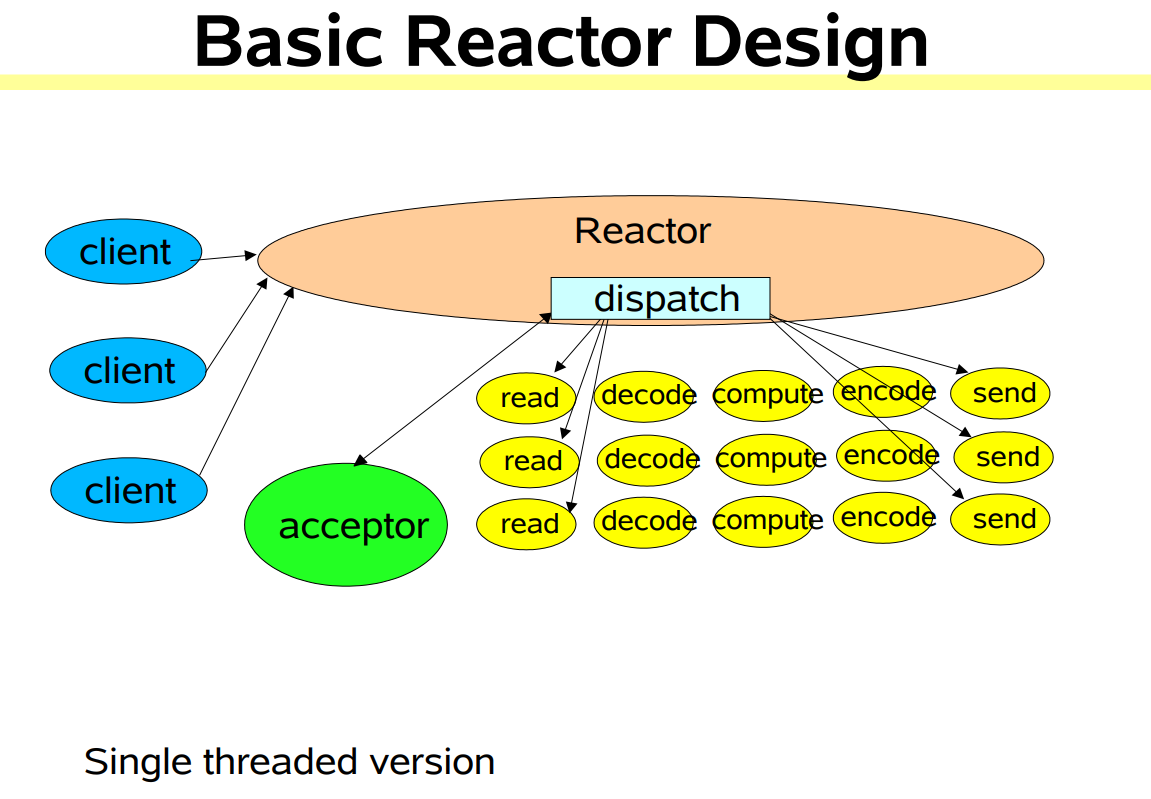
Single threaded version
java.nio Support
Channels
- Connections to files, sockets etc that support
- non-blocking reads
Buffers
- Array-like objects that can be directly read or written by Channels
Selectors
- Tell which of a set of Channels have IO events
SelectionKeys
Maintain IO event status and bindings
Reactor 1: Setup
class Reactor implements Runnable { final Selector selector; final ServerSocketChannel serverSocket; Reactor(int port) throws IOException { selector = Selector.open(); serverSocket = ServerSocketChannel.open(); serverSocket.socket().bind( new InetSocketAddress(port)); serverSocket.configureBlocking(false); SelectionKey sk = serverSocket.register(selector, SelectionKey.OP_ACCEPT); sk.attach(new Acceptor()); } /** * Alternatively, use explicit SPI provider: * SelectorProvider p = SelectorProvider.provider(); * selector = p.openSelector(); * serverSocket = p.openServerSocketChannel(); */ |
Reactor 2: Dispatch Loop
// class Reactor continuedpublic void run() { // normally in a new Thread try { while (!Thread.interrupted()) { selector.select(); Set selected = selector.selectedKeys(); Iterator it = selected.iterator(); while (it.hasNext()) dispatch((SelectionKey) (it.next()); selected.clear(); } } catch (IOException ex) { /* ... */ }}void dispatch(SelectionKey k) { Runnable r = (Runnable) (k.attachment()); if (r != null) r.run();} |
Reactor 3: Acceptor
// class Reactor continued class Acceptor implements Runnable { // inner public void run() { try { SocketChannel c = serverSocket.accept(); if (c != null) new Handler(selector, c); } catch (IOException ex) { /* ... */ } } }} |
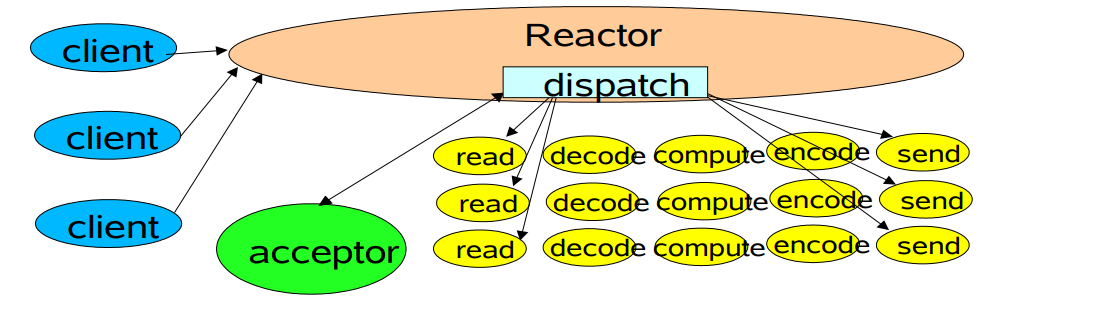
Reactor4: Handler setup
final class Handler implements Runnable { final SocketChannel socket; final SelectionKey sk; ByteBuffer input = ByteBuffer.allocate(MAXIN); ByteBuffer output = ByteBuffer.allocate(MAXOUT); static final int READING = 0, SENDING = 1; int state = READING; Handler(Selector sel, SocketChannel c) throws IOException { socket = c; c.configureBlocking(false); // Optionally try first read now sk = socket.register(sel, 0); sk.attach(this); sk.interestOps(SelectionKey.OP_READ); sel.wakeup(); } boolean inputIsComplete() { /* ... */ } boolean outputIsComplete() { /* ... */ } void process() { /* ... */ } |
Reactor 5: Request handling
// class Handler continued public void run() { try { if (state == READING) read(); else if (state == SENDING) send(); } catch (IOException ex) { /* ... */ } } void read() throws IOException { socket.read(input); if (inputIsComplete()) { process(); state = SENDING; // Normally also do first write now sk.interestOps(SelectionKey.OP_WRITE); } } void send() throws IOException { socket.write(output); if (outputIsComplete()) sk.cancel(); }} |
Per-State Handlers
- A simple use of GoF State-Object pattern
- Rebind appropriate handler as attachment
class Handler { // ... public void run() { // initial state is reader socket.read(input); if (inputIsComplete()) { process(); sk.attach(new Sender()); sk.interest(SelectionKey.OP_WRITE); sk.selector().wakeup(); } } class Sender implements Runnable { public void run() { // ... socket.write(output); if (outputIsComplete()) sk.cancel(); } }} |
Multithreaded Designs
- Strategically add threads for scalability
- Mainly applicable to multiprocessors
- Worker Threads
- Reactors should quickly trigger handlers
- Handler processing slows down Reactor
- Offload non-IO processing to other threads
- Reactors should quickly trigger handlers
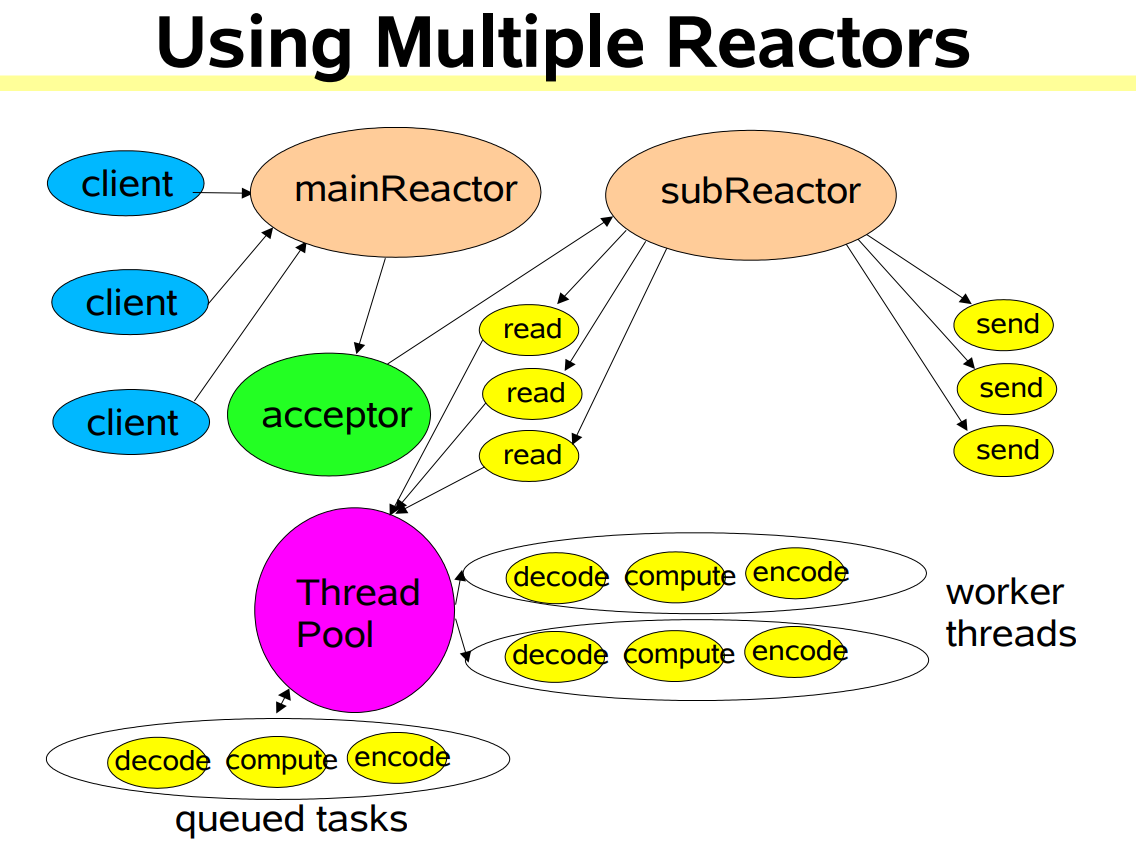
- Multiple Reactor Threads
- Reactor threads can saturate doing IO
- Distribute load to other reactors
- Load-balance to match CPU and IO rates
Worker Threads
- Offload non-IO processing to speed up Reactor thread
- Similar to POSA2 Proactor designs
- Simpler than reworking compute-bound processing into event-driven form
- Should still be pure nonblocking computation
- Enough processing to outweigh overhead
- Should still be pure nonblocking computation
- But harder to overlap processing with IO
- Best when can first read all input into a buffer
- Use thread pool so can tune and control
- Normally need many fewer threads than clientsWorker Thread Pools
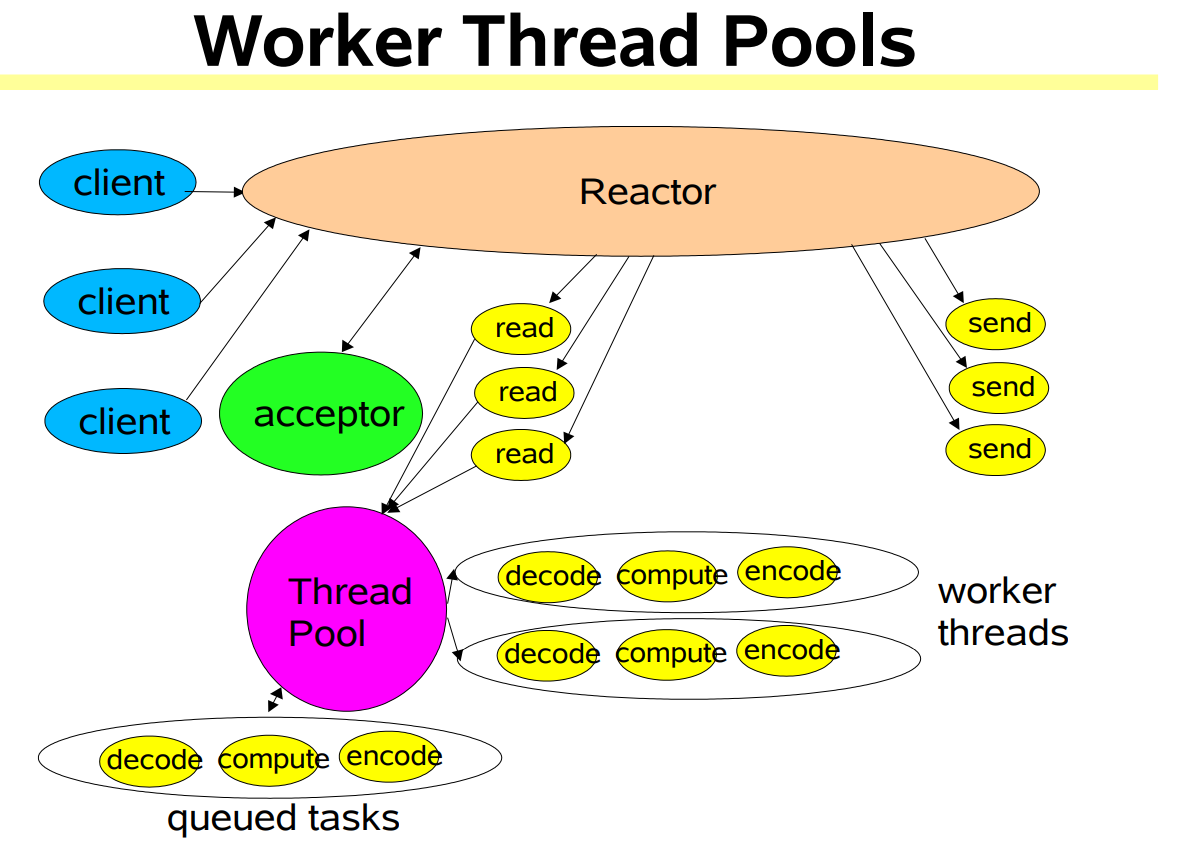
Handler with Thread Pool
class Handler implements Runnable { // uses util.concurrent thread pool static PooledExecutor pool = new PooledExecutor(...); static final int PROCESSING = 3; // ... synchronized void read() { // ... socket.read(input); if (inputIsComplete()) { state = PROCESSING; pool.execute(new Processer()); } } synchronized void processAndHandOff() { process(); state = SENDING; // or rebind attachment sk.interest(SelectionKey.OP_WRITE); } class Processer implements Runnable { public void run() { processAndHandOff(); } }} |
Coordinating Tasks
Handoffs
- Each task enables, triggers, or calls next one
- Usually fastest but can be brittle
Callbacks to per-handler dispatcher
- Sets state, attachment, etc
- A variant of GoF Mediator pattern
Queues
- For example, passing buffers across stages
Futures
- When each task produces a result
- Coordination layered on top of join or wait/notify
Using PooledExecutor
- A tunable worker thread pool
- Main method
execute(Runnable r) - Controls for:
- The kind of task queue (any Channel)
- Maximum number of threads
- Minimum number of threads
- "Warm" versus on-demand threads
- Keep-alive interval until idle threads die
- to be later replaced by new ones if necessary
- Saturation policy
- block, drop, producer-runs, etc
Multiple Reactor Threads
- Using Reactor Pools
- Use to match CPU and IO rates
- Static or dynamic construction
- Each with own Selector, Thread, dispatch loop
- Main acceptor distributes to other reactors
Selector[] selectors; // also create threadsint next = 0;class Acceptor { // ... public synchronized void run() { ... Socket connection = serverSocket.accept(); if (connection != null) new Handler(selectors[next], connection); if (++next == selectors.length) next = 0; }} |
Using Multiple Reactors
Using other java.nio features
- Multiple Selectors per Reactor
- To bind different handlers to different IO events
- May need careful synchronization to coordinate
- File transfer
- Automated file-to-net or net-to-file copying
- Memory-mapped files
- Access files via buffers
- Direct buffers
- Can sometimes achieve zero-copy transfer
- But have setup and finalization overhead
- Best for applications with long-lived connections
Connection-Based Extensions
- Instead of a single service request,
- Client connects
- Client sends a series of messages/requests
- Client disconnects
- Examples
- Databases and Transaction monitors
- Multi-participant games, chat, etc
- Can extend basic network service patterns
- Handle many relatively long-lived clients
- Track client and session state (including drops)
- Distribute services across multiple hosts
API Walkthrough
- Buffer
- ByteBuffer (CharBuffer, LongBuffer, etc not shown.)
- Channel
- SelectableChannel
- SocketChannel
- ServerSocketChannel
- FileChannel
- Selector
- SelectionKey
Buffer
abstract class Buffer { int capacity(); int position(); Buffer position(int newPosition); int limit(); Buffer limit(int newLimit); Buffer mark(); Buffer reset(); Buffer clear(); Buffer flip(); Buffer rewind(); int remaining(); boolean hasRemaining(); boolean isReadOnly();} |
ByteBuffer
abstract class ByteBuffer extends Buffer { static ByteBuffer allocateDirect(int capacity); static ByteBuffer allocate(int capacity); static ByteBuffer wrap(byte[] src, int offset, int len); static ByteBuffer wrap(byte[] src); boolean isDirect(); ByteOrder order(); ByteBuffer order(ByteOrder bo); ByteBuffer slice(); ByteBuffer duplicate(); ByteBuffer compact(); ByteBuffer asReadOnlyBuffer(); byte get(); byte get(int index); ByteBuffer get(byte[] dst, int offset, int length); ByteBuffer get(byte[] dst); ByteBuffer put(byte b); ByteBuffer put(int index, byte b); ByteBuffer put(byte[] src, int offset, int length); ByteBuffer put(ByteBuffer src); ByteBuffer put(byte[] src); char getChar(); char getChar(int index); ByteBuffer putChar(char value); ByteBuffer putChar(int index, char value); CharBuffer asCharBuffer(); short getShort(); short getShort(int index); ByteBuffer putShort(short value); ByteBuffer putShort(int index, short value); ShortBuffer asShortBuffer(); int getInt(); int getInt(int index); ByteBuffer putInt(int value); ByteBuffer putInt(int index, int value); IntBuffer asIntBuffer(); long getLong(); long getLong(int index); ByteBuffer putLong(long value); ByteBuffer putLong(int index, long value); LongBuffer asLongBuffer(); float getFloat(); float getFloat(int index); ByteBuffer putFloat(float value); ByteBuffer putFloat(int index, float value); FloatBuffer asFloatBuffer(); double getDouble(); double getDouble(int index); ByteBuffer putDouble(double value); ByteBuffer putDouble(int index, double value); DoubleBuffer asDoubleBuffer();} |
Channel
interface Channel { boolean isOpen(); void close() throws IOException;}interface ReadableByteChannel extends Channel { int read(ByteBuffer dst) throws IOException;}interface WritableByteChannel extends Channel { int write(ByteBuffer src) throws IOException;}interface ScatteringByteChannel extends ReadableByteChannel { int read(ByteBuffer[] dsts, int offset, int length) throws IOException; int read(ByteBuffer[] dsts) throws IOException;}interface GatheringByteChannel extends WritableByteChannel { int write(ByteBuffer[] srcs, int offset, int length) throws IOException; int write(ByteBuffer[] srcs) throws IOException;} |
SelectableChannel
abstract class SelectableChannel implements Channel { int validOps(); boolean isRegistered(); SelectionKey keyFor(Selector sel); SelectionKey register(Selector sel, int ops) throws ClosedChannelException; SelectionKey register(Selector sel, int ops, Object att) throws ClosedChannelException; void configureBlocking(boolean block) throws IOException; boolean isBlocking(); Object blockingLock();} |
SocketChannel
abstract class SocketChannel implements ByteChannel ... { static SocketChannel open() throws IOException; Socket socket(); int validOps(); boolean isConnected(); boolean isConnectionPending(); boolean isInputOpen(); boolean isOutputOpen(); boolean connect(SocketAddress remote) throws IOException; boolean finishConnect() throws IOException; void shutdownInput() throws IOException; void shutdownOutput() throws IOException; int read(ByteBuffer dst) throws IOException; int read(ByteBuffer[] dsts, int offset, int length) throws IOException; int read(ByteBuffer[] dsts) throws IOException; int write(ByteBuffer src) throws IOException; int write(ByteBuffer[] srcs, int offset, int length) throws IOException; int write(ByteBuffer[] srcs) throws IOException;} |
ServerSocketChannel
abstract class ServerSocketChannel extends ... { static ServerSocketChannel open() throws IOException; int validOps(); ServerSocket socket(); SocketChannel accept() throws IOException;} |
FileChannel
abstract class FileChannel implements ... { int read(ByteBuffer dst); int read(ByteBuffer dst, long position); int read(ByteBuffer[] dsts, int offset, int length); int read(ByteBuffer[] dsts); int write(ByteBuffer src); int write(ByteBuffer src, long position); int write(ByteBuffer[] srcs, int offset, int length); int write(ByteBuffer[] srcs); long position(); void position(long newPosition); long size(); void truncate(long size); void force(boolean flushMetaDataToo); int transferTo(long position, int count, WritableByteChannel dst); int transferFrom(ReadableByteChannel src, long position, int count); FileLock lock(long position, long size, boolean shared); FileLock lock(); FileLock tryLock(long pos, long size, boolean shared); FileLock tryLock(); static final int MAP_RO, MAP_RW, MAP_COW; MappedByteBuffer map(int mode, long position, int size);} |
NOTE: ALL methods throw IOException
Selector
abstract class Selector { static Selector open() throws IOException; Set keys(); Set selectedKeys(); int selectNow() throws IOException; int select(long timeout) throws IOException; int select() throws IOException; void wakeup(); void close() throws IOException;} |
SelectionKey
abstract class SelectionKey { static final int OP_READ, OP_WRITE, OP_CONNECT, OP_ACCEPT; SelectableChannel channel(); Selector selector(); boolean isValid(); void cancel(); int interestOps(); void interestOps(int ops); int readyOps(); boolean isReadable(); boolean isWritable(); boolean isConnectable(); boolean isAcceptable(); Object attach(Object ob); Object attachment();} |